Solar monitoring earns its keep on the day it catches something you would have missed. Last week one of our own systems did exactly that. A homeowner running a parallel EG4 system noticed their stronger inverter mysteriously losing about two-thirds of its output for a couple of hours every sunny afternoon. No clouds, no shade, no obvious cause. Here is how a temperature alert and FourScoped's Hyper Mode turned a baffling intermittent problem into a clear, fixable diagnosis, and what it means for your own system.
The symptom: power that vanished in the afternoon sun
On a multi-inverter site, you expect both inverters to track each other through the day, rising and falling together as the sun moves. Instead, the inverter with more panels and better orientation, the one that should have produced the most, was dropping out by roughly two-thirds for a sustained stretch in the early afternoon. The other inverter held steady the whole time.
This is the kind of problem that drives people crazy, because the usual suspects do not fit. It was not shading (the dip lasted nearly two hours, not a passing cloud). It was not a single bad string (all of that inverter's strings dropped together, so it was an inverter-level event). And it was not export throttling, which would have affected both units. Something was happening to one inverter, and only in the heat of the day.
The clue: temperature crossing a threshold
The breakthrough came from a number most people never look at: inverter temperature. Right as production dropped, the internal temperature on the affected inverter climbed to about 70°C and then hovered there. The timing was not a coincidence. Power fell exactly when heat rose.
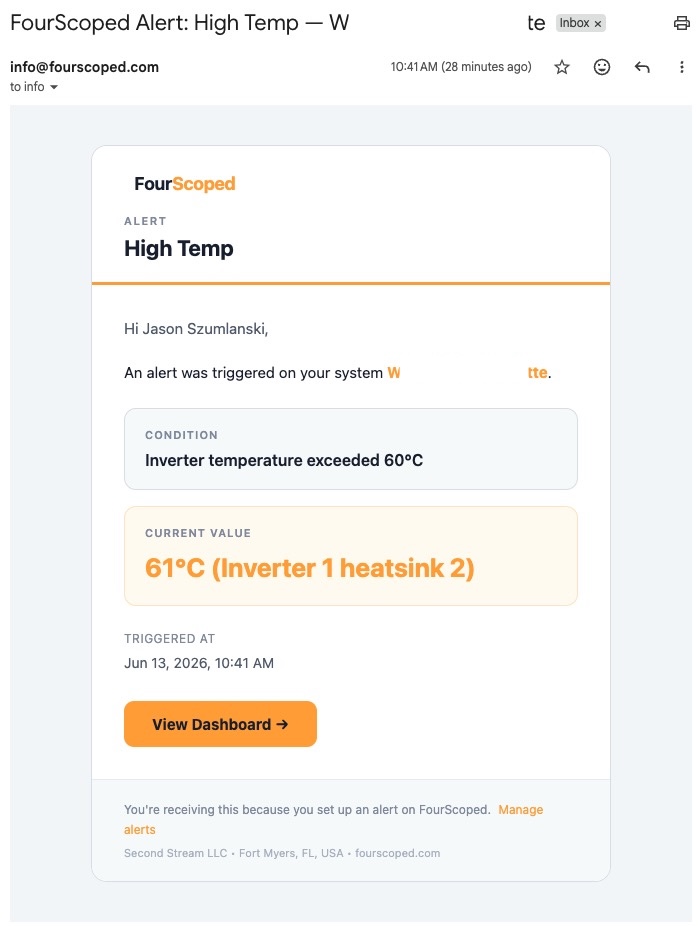
That is the moment a temperature alert pays for itself. FourScoped lets you set an alert that watches both the inverter's internal temperature and every heatsink sensor, and emails you the instant any of them crosses a threshold you choose. The default is 70°C, which is deliberately conservative: it is the point where these inverters start making protective decisions, well before anything is actually at risk. An alert at that threshold turns an invisible, intermittent event into a timestamped notification sitting in your inbox.
Why 70°C? It is early enough to catch a heat problem while it is still just a performance issue, not a hardware one. You would rather get the email on the warm afternoon than discover months of quietly clipped production later.
In this case, we wanted to catch the rising temperature early, so we set an alert at 60ºC.
The diagnosis: Hyper Mode made the cause obvious
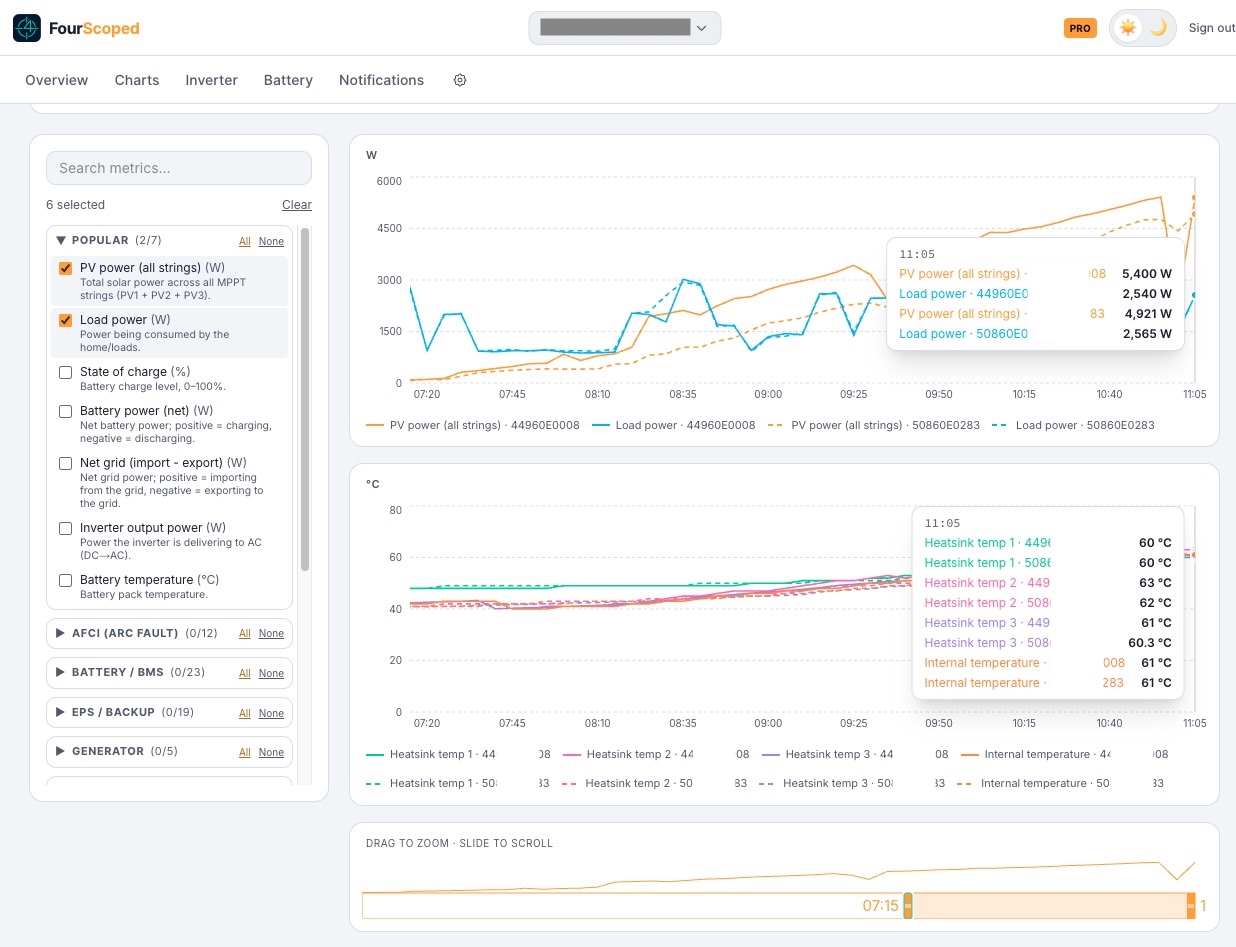
An alert tells you something happened. To understand why, you need to see the metrics side by side, and that is what Hyper Mode is built for. It lets you pull up to 93 metrics from your EG4 system across a full week, in roughly five-minute increments, and plot every inverter on the same timeline at once.
Overlaying PV power and the temperature sensors told the whole story in a single glance. On the affected inverter, the internal temperature and heatsinks marched up to about 70°C, leveled off, and the solar output throttled down to hold that line. Then, when the cooling fans finally kicked in, the temperatures plummeted and production snapped right back. The healthy inverter, with fewer panels and a bit less heat load, never reached the tipping point, which is exactly why only one of the two units showed the problem.
That is the difference between guessing and knowing. The raw EG4 charts show one metric at a time and report instantaneous power snapshots that bounce around on their own. Hyper Mode let us line up cause and effect, on the specific inverter, at the specific minutes it mattered.
The fix: a firmware update to the fan logic
With the cause confirmed, the fix was straightforward. On the older firmware, the cooling fans were set to engage at 6 kW of solar production or 75°C. The problem is that on a hot, high-producing afternoon, the inverter would creep up near its temperature limit and start throttling power to protect itself before the fans ever turned on. It was choosing to make less power rather than run hot.
The updated firmware lowers the fan-activation threshold from 6 kW to 4 kW of production. In plain terms: the fans now come on earlier, cooling the inverter before it ever has to throttle. We performed the update on site, and the afternoon dropouts are gone. The system is producing the way it was designed to.
What this means for your system
You do not need to be chasing a problem to benefit from this. A few takeaways worth applying today:
- Turn on a temperature alert. Set it to the 70°C default (or your own threshold) and let FourScoped watch the internal and heatsink sensors for you. Heat-related throttling is silent and easy to miss, especially in summer.
- When something looks off, reach for Hyper Mode. Plotting power against temperature, all inverters together, over several days, turns "why is this happening?" into an answer you can act on.
- Keep your firmware current. This particular fix lived in a firmware update. Knowing what version you are on and what each release changes can be the whole solution.
- Watch energy, not just instantaneous power. Real performance shows up in kilowatt-hours over time. A sustained drop in energy is a real signal; a jagged power snapshot usually is not.
The best monitoring does not just show you pretty graphs when everything is fine. It hands you the alert and the evidence when something is wrong, so a confusing two-hour mystery becomes a one-line diagnosis and a quick fix. That is exactly what temperature alerts and Hyper Mode are for.